
LV202-open函数解析2
本文主要是 kernel——open 函数系统调用过程中,dentry 结构的创建以及如何通过 inode 查找和关联的过程。从 d_alloc_parallel()开始,经 d_alloc()、__d_alloc()函数,最终在 ext4_lookup()中找到 inode,并在 d_splice_alias()和__d_add()函数中完成 dentry 与 inode 的绑定,确保后续 lookup 快速定位。
一、open 函数调用回顾
这里还是先以打开前面的 demo 为例:
#include <stdio.h>
#include <sys/types.h>
#include <sys/stat.h>
#include <fcntl.h>
#include <unistd.h>

int main(int argc, char* argv[])
{
    int fd = open("/home/sumu/7Linux/test.txt", O_CREAT | O_RDWR);
    close(fd);
    return 0;
}回顾一下 open 函数的调用过程:
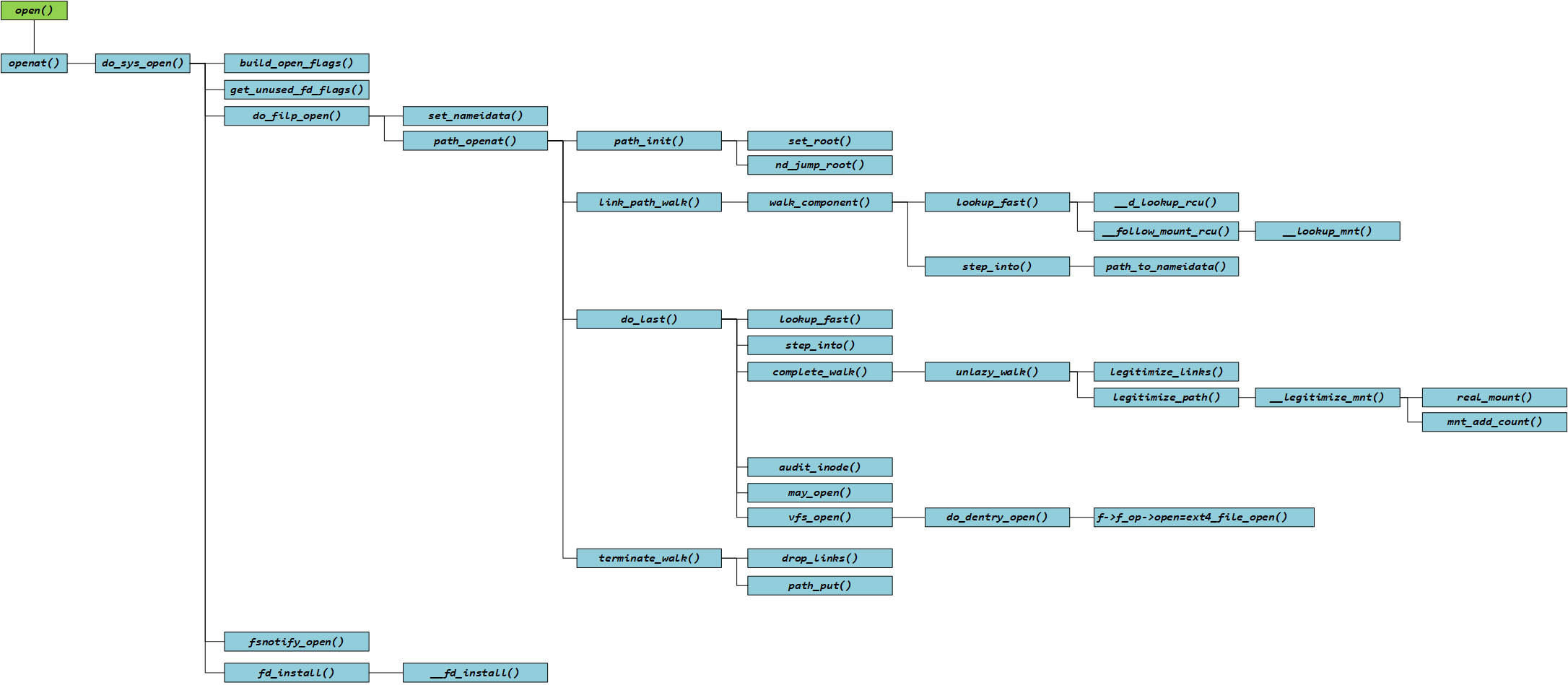
在《01 嵌入式开发/02IMX6ULL 平台/LV05-系统镜像/LV05-03-Kernel-05-03-02-open 函数解析 1.md》里面我们以打开 "/home/sumu/7Linux/test.txt" 为例分析了系统调用 "open" 的内核实现。其中我们假设了路径名中所有部分的 dentry 结构体均已存在在系统缓存中。即通过 lookup_fast() 函数成功找到目标文件的 dentry。那要是这个函数调用失败了,没有找到目标文件的 dentry 怎么办?这一节就来分析一下吧。
二、walk_component()分析
我们直接来到 walk_component() 函数中:
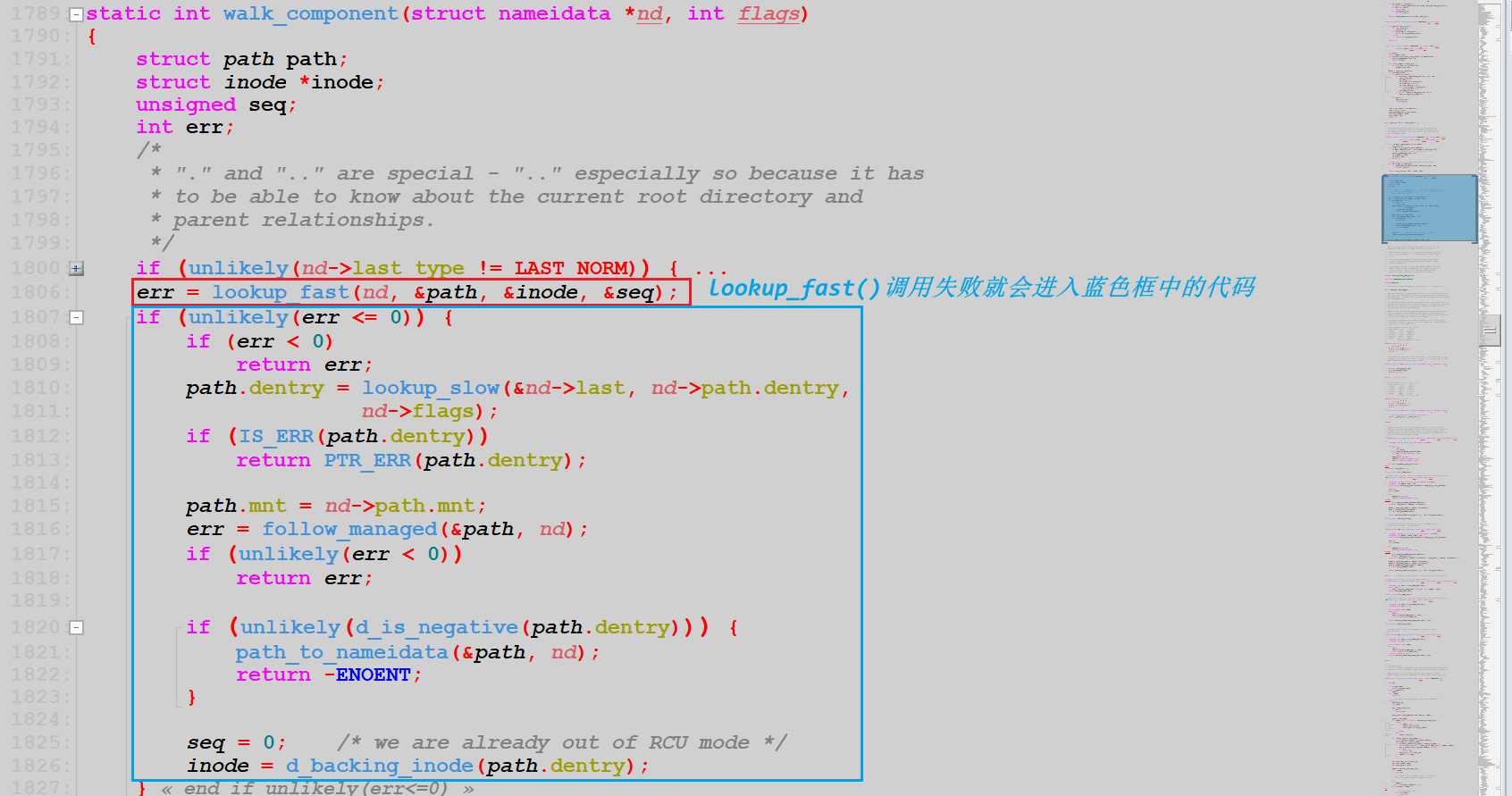
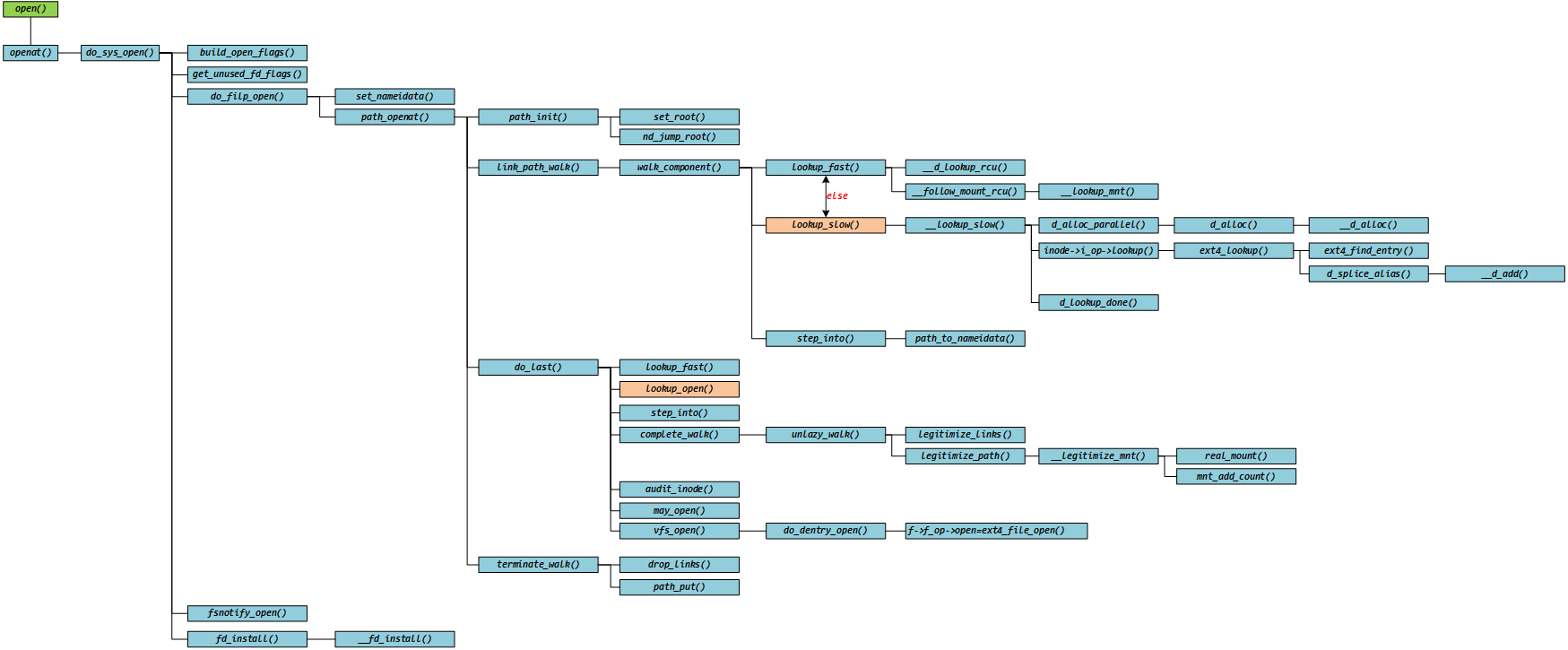
在 walk_component() 函数通过调用 lookup_fast() 函数失败时,进入 lookup_slow() 函数。在 lookup_slow() 函数为目标文件创建一个新的 dentry,并加入到系统缓存中。现来分析其具体过程,例如假设文件夹“sumu”尚不存在在系统缓存中(虽然这种情况几乎不存在)。
说明:在这里我们仍然不考虑函数调用失败和进程同步等问题)
1. lookup_slow()
lookup_slow() 函数定义如下:
static struct dentry *lookup_slow(const struct qstr *name,
				  struct dentry *dir,
				  unsigned int flags)
{
	struct inode *inode = dir->d_inode;
	struct dentry *res;
	inode_lock_shared(inode);
	res = __lookup_slow(name, dir, flags);
	inode_unlock_shared(inode);
	return res;
}可以看到 lookup_slow() 函数内部调用了 [__lookup_slow()](https://git.kernel.org/pub/scm/linux/kernel/git/stable/linux.git/tree/fs/namei.c?h = v4.19.71&id = e7d2672c66e4d3675570369bf20856296da312c4#n1642) 函数:
/* Fast lookup failed, do it the slow way */
static struct dentry *__lookup_slow(const struct qstr *name,
				    struct dentry *dir,
				    unsigned int flags)
{
	struct dentry *dentry, *old;
	struct inode *inode = dir->d_inode;
	DECLARE_WAIT_QUEUE_HEAD_ONSTACK(wq);

	/* Don't go there if it's already dead */
	if (unlikely(IS_DEADDIR(inode))) // if 判断为 0
		//......
again:
	dentry = d_alloc_parallel(dir, name, &wq);
	if (IS_ERR(dentry)) // if 判断为 0
		//......
	if (unlikely(!d_in_lookup(dentry))) { // 不考虑并发性问题, if 判断为 0
		//......
	} else {
		old = inode->i_op->lookup(inode, dentry, flags);// 一般情况下,返回 NULL
		d_lookup_done(dentry);
		if (unlikely(old)) { // if 判断为 0
			//......
		}
	}
	return dentry;
}1.1 d_alloc_parallel()
先来分析其中的 d_alloc_parallel() 函数。在我们分析的这种情况下,该函数定义等价与如下,(该函数涉及很多并发性问题的考虑,参考 《Parallel pathname lookups and the importance of testing》 ):
struct dentry *d_alloc_parallel(struct dentry *parent,
				const struct qstr *name,
				wait_queue_head_t *wq)
{
	unsigned int hash = name->hash;
	struct hlist_bl_head *b = in_lookup_hash(parent, hash);
	struct hlist_bl_node *node;
	struct dentry *new = d_alloc(parent, name);
	struct dentry *dentry;
	unsigned seq, r_seq, d_seq;

	if (unlikely(!new)) // if 判断为 0
		//......

retry:
	rcu_read_lock();
	seq = smp_load_acquire(&parent->d_inode->i_dir_seq);
	r_seq = read_seqbegin(&rename_lock);
	dentry = __d_lookup_rcu(parent, name, &d_seq);
	if (unlikely(dentry)) { // if 判断为 0(dentry 刚刚被创建和初始化,但尚未被加入哈希表中 (不考虑并发性问题))
		//......
	}
	if (unlikely(read_seqretry(&rename_lock, r_seq))) {// 暂不考虑并发性问题,假设此时无需 retry, if 判断为 0
		//......
	}

	if (unlikely(seq & 1)) {
		rcu_read_unlock();
		goto retry;
	}

	hlist_bl_lock(b);
	if (unlikely(READ_ONCE(parent->d_inode->i_dir_seq) != seq)) { // 暂不考虑,假设 if 判断为 0
		//......
	}
	/*
	 * No changes for the parent since the beginning of d_lookup().
	 * Since all removals from the chain happen with hlist_bl_lock(),
	 * any potential in-lookup matches are going to stay here until
	 * we unlock the chain.  All fields are stable in everything
	 * we encounter.
	 */
    // 遍历 in_lookup_hashtable,在不考虑并发性的问题情况下,新创建的这个 dentry 在 in_lookup_hashtable 中也找不到
	hlist_bl_for_each_entry(dentry, node, b, d_u.d_in_lookup_hash) {
		if (dentry->d_name.hash != hash) //if 判断始终为 1, 直到整个遍历结束
			continue;
		//......
	}
	rcu_read_unlock();
	/* we can't take -> d_lock here; it's OK, though. */
	new->d_flags |= DCACHE_PAR_LOOKUP;
	new->d_wait = wq;
    // 将新创建的 dentry 加入到 in_lookup_hashtable 中,以便并发访问的其他程序能够找到,不会重复创建相同 dentry
	hlist_bl_add_head_rcu(&new->d_u.d_in_lookup_hash, b);
	hlist_bl_unlock(b);
	return new; // 函数返回
mismatch:
	//......
}
EXPORT_SYMBOL(d_alloc_parallel);1.1.1 d_alloc()
先看 d_alloc() 函数。在目前分析的情况下该函数等价如下:
/**
 * d_alloc	-	allocate a dcache entry
 * @parent: parent of entry to allocate
 * @name: qstr of the name
 *
 * Allocates a dentry. It returns %NULL if there is insufficient memory
 * available. On a success the dentry is returned. The name passed in is
 * copied and the copy passed in may be reused after this call.
 */
struct dentry *d_alloc(struct dentry * parent, const struct qstr *name)
{
	struct dentry *dentry = __d_alloc(parent->d_sb, name);
	if (!dentry)
		return NULL;
	spin_lock(&parent->d_lock);
	/*
	 * don't need child lock because it is not subject
	 * to concurrency here
	 */
	__dget_dlock(parent);
	dentry->d_parent = parent;
	list_add(&dentry->d_child, &parent->d_subdirs);//将新创建的 dentry-> d_child 加入 父目录的 dentry-> d_subdirs 链后面,此处不做详细分析
	spin_unlock(&parent->d_lock);

	return dentry;
}
EXPORT_SYMBOL(d_alloc);1.1.2 __d_alloc()
看一下 d_alloc() 中的[__d_alloc()](https://git.kernel.org/pub/scm/linux/kernel/git/stable/linux.git/tree/fs/dcache.c?h = v4.19.71&id = e7d2672c66e4d3675570369bf20856296da312c4#n1594) 函数,在这里分析如下:
struct dentry *__d_alloc(struct super_block *sb, const struct qstr *name)
{
	struct external_name *ext = NULL;
	struct dentry *dentry;
	char *dname;
	int err;

	dentry = kmem_cache_alloc(dentry_cache, GFP_KERNEL);
	if (!dentry)
		return NULL;

	/*
	 * We guarantee that the inline name is always NUL-terminated.
	 * This way the memcpy() done by the name switching in rename
	 * will still always have a NUL at the end, even if we might
	 * be overwriting an internal NUL character
	 */
	dentry->d_iname[DNAME_INLINE_LEN-1] = 0;
	if (unlikely(!name)) {//这里 if 判断结果为 0
		//......
	} else if (name->len > DNAME_INLINE_LEN-1) {//DNAME_INLINE_LEN = 32, name ~ sumu/7Linux/test.txt, if 判断为 0
		//......
	} else  {
		dname = dentry->d_iname;
	}

	dentry->d_name.len = name->len;
	dentry->d_name.hash = name->hash;
	memcpy(dname, name->name, name->len);
	dname[name->len] = 0;

	/* Make sure we always see the terminating NUL character */
	smp_store_release(&dentry->d_name.name, dname); /* ^^^ */
	// 到这里,由于 name-> len 小于 dentry-> d_iname 数组的大小,因此 dentry-> d_iname 和 dentry-> d_name 指向的是同一个名字(sumu/7Linux/test.txt)

    //下面是根据参数 struct qstr *name 和 struct super_block * sb 提供的信息初始化刚刚创建的 dentry
	dentry->d_lockref.count = 1;
	dentry->d_flags = 0;
	spin_lock_init(&dentry->d_lock);
	seqcount_init(&dentry->d_seq);
	dentry->d_inode = NULL; // 注意,d_inode 没有赋值,整个 dentry 只能算是个空壳...
	dentry->d_parent = dentry;
	dentry->d_sb = sb;
	dentry->d_op = NULL;
	dentry->d_fsdata = NULL;
	INIT_HLIST_BL_NODE(&dentry->d_hash);
	INIT_LIST_HEAD(&dentry->d_lru);
	INIT_LIST_HEAD(&dentry->d_subdirs);
	INIT_HLIST_NODE(&dentry->d_u.d_alias);
	INIT_LIST_HEAD(&dentry->d_child);
	d_set_d_op(dentry, dentry->d_sb->s_d_op); // 在本例中 dentry-> d_op = sb-> s_d_op (== NULL)

	if (dentry->d_op && dentry->d_op->d_init) { // dentry-> d_op == 0
		//......
	}

	if (unlikely(ext)) {
		pg_data_t *pgdat = page_pgdat(virt_to_page(ext));
		mod_node_page_state(pgdat, NR_INDIRECTLY_RECLAIMABLE_BYTES,
				    ksize(ext));
	}

	this_cpu_inc(nr_dentry);

	return dentry;
}可见,在 [__d_alloc()](https://git.kernel.org/pub/scm/linux/kernel/git/stable/linux.git/tree/fs/dcache.c?h = v4.19.71&id = e7d2672c66e4d3675570369bf20856296da312c4#n1594) 函数中,创建新的 struct dentry,并根据 父目录的 dentry→ d_sb 和本目录的 name 进行相关初始化。该函数返回之后,我们回到 [d_alloc()](https://git.kernel.org/pub/scm/linux/kernel/git/stable/linux.git/tree/fs/dcache.c?h = v4.19.71&id = e7d2672c66e4d3675570369bf20856296da312c4#n1684) 函数。在 [d_alloc()](https://git.kernel.org/pub/scm/linux/kernel/git/stable/linux.git/tree/fs/dcache.c?h = v4.19.71&id = e7d2672c66e4d3675570369bf20856296da312c4#n1684) 函数调用完毕 [__d_alloc()](https://git.kernel.org/pub/scm/linux/kernel/git/stable/linux.git/tree/fs/dcache.c?h = v4.19.71&id = e7d2672c66e4d3675570369bf20856296da312c4#n1594) 函数之后,再对新创建的 dentry 进行简单设置之后便返回了,详见上面代码部分。
1.1.3 总结

d_alloc() 函数结束之后返回到 d_alloc_parallel() 函数。d_alloc_parallel() 函数执行完 d_alloc() 函数之后,进行简单操作(不考虑并发性问题的考虑)之后,返回新创建的 dentry。d_alloc_parallel() 函数返回之后,便回到[__lookup_slow()](https://git.kernel.org/pub/scm/linux/kernel/git/stable/linux.git/tree/fs/namei.c?h = v4.19.71&id = e7d2672c66e4d3675570369bf20856296da312c4#n1642) 函数。
1.2 ext4_lookup()
需要注意的是,在整个 d_alloc_parallel() 函数中,只是创建了一个新的 dentry,但还没找到相应的 inode,整个 dentry 目前只是一具空壳。下面将进入 inode→ i_op→ lookup() 函数,在这个函数中,将找到相应的 inode,并与 dentry 联系起来。这是一个函数指针,要分析该函数需知道该指针指向的函数。其实该指针指向的是 ext4_lookup() 函数。为什么?其实这个函数根据不同文件系统指向不同的函数,但是大概都叫 xxx_lookup(),我们可以在 fs - kernel/git/stable/linux.git - Linux kernel stable tree 目录中搜索一下:
grep -nRw "lookup" ./fs/就会找到,若是 ext4 文件系统的话,就会指向这个 ext4_lookup() 函数,该函数定义如下:
static struct dentry *ext4_lookup(struct inode *dir, struct dentry *dentry, unsigned int flags)
{
	struct inode *inode;
	struct ext4_dir_entry_2 *de;
	struct buffer_head *bh;
	int err;

	err = fscrypt_prepare_lookup(dir, dentry, flags);
	if (err) // if 判断为 0
		//......

	if (dentry->d_name.len > EXT4_NAME_LEN) // if 判断为 0
		//......
	/***** **** 根据父目录和目标文件的文件名,找到目标文件的 inode **** *****/
	bh = ext4_find_entry(dir, &dentry->d_name, &de, NULL);
	if (IS_ERR(bh))
		return (struct dentry *) bh;
	inode = NULL;
	if (bh) {
		__u32 ino = le32_to_cpu(de->inode);
		brelse(bh);
		if (!ext4_valid_inum(dir->i_sb, ino)) {
			EXT4_ERROR_INODE(dir, "bad inode number: %u", ino);
			return ERR_PTR(-EFSCORRUPTED);
		}
		if (unlikely(ino == dir->i_ino)) {
			EXT4_ERROR_INODE(dir, "'%pd' linked to parent dir",
					 dentry);
			return ERR_PTR(-EFSCORRUPTED);
		}
		inode = ext4_iget(dir->i_sb, ino, EXT4_IGET_NORMAL);
		if (inode == ERR_PTR(-ESTALE)) {
			EXT4_ERROR_INODE(dir,
					 "deleted inode referenced: %u",
					 ino);
			return ERR_PTR(-EFSCORRUPTED);
		}
		if (!IS_ERR(inode) && ext4_encrypted_inode(dir) &&
		    (S_ISDIR(inode->i_mode) || S_ISLNK(inode->i_mode)) &&
		    !fscrypt_has_permitted_context(dir, inode)) {
			ext4_warning(inode->i_sb,
				     "Inconsistent encryption contexts: %lu/%lu",
				     dir->i_ino, inode->i_ino);
			iput(inode);
			return ERR_PTR(-EPERM);
		}
	}
    /***** **** **** **** **** **** **** **** **** **** **** **** **** **** **** ******/
	return d_splice_alias(inode, dentry);
}可见这个函数中大部分代码是用来找到目标文件的 inode。因为在前面的代码中,只是创建了一个 dentry 的“空壳”,还没有与任何一个 inode 相关联,这个 dentry 的 d_inode 被初始化为 dentry→ d_inode = NULL。在 ext4_lookup() 这个函数中找到对应的 inode。这也符合这个函数的名字:lookup, 就是要找到 inode。这里寻找 inode 的过程依赖 ext4 文件系统的配置和技术细节,这里将不进行深入分析了。
1.2.1 d_splice_alias()
而在这个函数的最后一部分,d_splice_alias() 函数中,将新创建的 dentry 与找到的 inode 进行关联,并顺便将新的 dentry 加入到哈希表中,这样下次执行 lookup_fast() 函数时,即可迅速找到可用的 dentry。下面看 d_splice_alias() 函数的定义:
struct dentry *d_splice_alias(struct inode *inode, struct dentry *dentry)
{
	if (IS_ERR(inode))
		return ERR_CAST(inode);

	BUG_ON(!d_unhashed(dentry));

	if (!inode)
		goto out;

	security_d_instantiate(dentry, inode);// 暂不分析该函数,可认为该函数什么都不做
	spin_lock(&inode->i_lock);
	if (S_ISDIR(inode->i_mode)) { // 判断是否为文件夹,if 判断为 1
		struct dentry *new = __d_find_any_alias(inode);//我们只考虑最简单的情况,一般情况下 new == NULL
		if (unlikely(new)) {//一般情况下, if 判断为 0
			//......
		}
	}
out:
	__d_add(dentry, inode);
	return NULL;
}
EXPORT_SYMBOL(d_splice_alias);可见,这个函数里面只调用了[__d_add()](https://git.kernel.org/pub/scm/linux/kernel/git/stable/linux.git/tree/fs/dcache.c?h = v4.19.71&id = e7d2672c66e4d3675570369bf20856296da312c4#n2561) 函数。该函数定义如下:
static inline void __d_add(struct dentry *dentry, struct inode *inode)
{
	struct inode *dir = NULL;
	unsigned n;
	spin_lock(&dentry->d_lock);
	if (unlikely(d_in_lookup(dentry))) { // 此处 if 判断为 1,但这里我们并不做具体分析
		dir = dentry->d_parent->d_inode;
		n = start_dir_add(dir);
		__d_lookup_done(dentry);
	}
	if (inode) { // if 判断为 1
		unsigned add_flags = d_flags_for_inode(inode);
		hlist_add_head(&dentry->d_u.d_alias, &inode->i_dentry);
		raw_write_seqcount_begin(&dentry->d_seq);
		__d_set_inode_and_type(dentry, inode, add_flags); // 设置 dentry 的 inode 和 flags
		raw_write_seqcount_end(&dentry->d_seq);
		fsnotify_update_flags(dentry);
	}
	__d_rehash(dentry); // 此时新创建的 dentry 已经完全可用,将其加入到 哈希表 中
	if (dir) // if 判断为 1,但此处不做分析
		end_dir_add(dir, n);
	spin_unlock(&dentry->d_lock);
	if (inode)
		spin_unlock(&inode->i_lock);
}可见,在这个函数中,最终设置了 dentry 的 inode,并将其加入到哈希表中,如此一来,下次可直接通过 lookup_fast() 函数找到该 dentry。
1.2.2 总结
[__d_add()](https://git.kernel.org/pub/scm/linux/kernel/git/stable/linux.git/tree/fs/dcache.c?h = v4.19.71&id = e7d2672c66e4d3675570369bf20856296da312c4#n2561) 函数返回后,回到 [d_splice_alias()](https://git.kernel.org/pub/scm/linux/kernel/git/stable/linux.git/tree/fs/dcache.c?h = v4.19.71&id = e7d2672c66e4d3675570369bf20856296da312c4#n2897) 函数,之后又返回到 [ext4_lookup()](https://git.kernel.org/pub/scm/linux/kernel/git/stable/linux.git/tree/fs/ext4/namei.c?h = v4.19.71&id = e7d2672c66e4d3675570369bf20856296da312c4#n1560) 函数,之后又返回到 [__lookup_slow()](https://git.kernel.org/pub/scm/linux/kernel/git/stable/linux.git/tree/fs/namei.c?h = v4.19.71&id = e7d2672c66e4d3675570369bf20856296da312c4#n1642) 函数, [__lookup_slow()](https://git.kernel.org/pub/scm/linux/kernel/git/stable/linux.git/tree/fs/namei.c?h = v4.19.71&id = e7d2672c66e4d3675570369bf20856296da312c4#n1642) 函数紧接着调用 [lookup_done()](https://git.kernel.org/pub/scm/linux/kernel/git/stable/linux.git/tree/include/linux/dcache.h?h = v4.19.71&id = e7d2672c66e4d3675570369bf20856296da312c4#n364) 函数,这个函数只是处理并发性问题,这里我们不考虑,可以认为该函数什么都没做。在这之后, [__lookup_slow()](https://git.kernel.org/pub/scm/linux/kernel/git/stable/linux.git/tree/fs/namei.c?h = v4.19.71&id = e7d2672c66e4d3675570369bf20856296da312c4#n1642) 函数返回至 [lookup_slow()](https://git.kernel.org/pub/scm/linux/kernel/git/stable/linux.git/tree/fs/namei.c?h = v4.19.71&id = e7d2672c66e4d3675570369bf20856296da312c4#n1681) 函数,然后继续返回到 [walk_component()](https://git.kernel.org/pub/scm/linux/kernel/git/stable/linux.git/tree/fs/namei.c?h = v4.19.71&id = e7d2672c66e4d3675570369bf20856296da312c4#n1789) 函数,后面执行的操作和我们所《01 嵌入式开发/02IMX6ULL 平台/LV05-系统镜像/LV05-03-Kernel-05-03-02-open 函数解析 1.md》里面分析的一样。

三、 lookup_open()
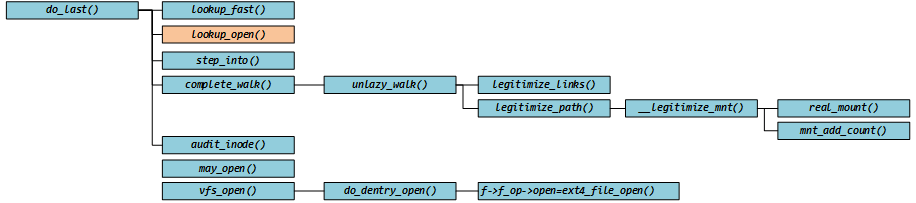
注意,如果是路径名的最后一部分不在 dcache 中,那么创建 dentry 以及查找 inode 的操作不在 lookup_slow() 函数中进行,而是在 do_last() 函数中,通过调用 lookup_open() 函数来完成,调用的部分在这一行 do_last() → lookup_open() 与上述过程略有不同,但基本过程是一样的,这里就不详细去分析了。
四、总结
分析到现在,我们对 open 的分析涉及到这些函数了:
参考资料
Linux 中 open 命令实现原理以及源码分析_linux open-CSDN 博客
linux 文件描述符分配实现详解(基于 ARM 处理器)_fdtable-CSDN 博客