
LV050-设备树插件驱动分析
设备树插件也是用的 configfs,来了解一下?若笔记中有错误或者不合适的地方,欢迎批评指正 😃。
一、源码分析
1. dtbocfg_module_init()
先来看模块的初始化函数 dtbocfg_module_init():
/**
 * dtbocfg_module_init()
 */
static int __init dtbocfg_module_init(void)
{
    int retval = 0;

    pr_info(DRIVER_NAME ": " DRIVER_VERSION "\n");

    config_group_init(&dtbocfg_root_subsys.su_group);
    config_group_init_type_name(&dtbocfg_overlay_group, "overlays", &dtbocfg_overlays_type);

    retval = configfs_register_subsystem(&dtbocfg_root_subsys);
    if (retval != 0) {
        pr_err( "%s: couldn't register subsys\n", __func__);
        goto register_subsystem_failed;
    }

    retval = configfs_register_group(&dtbocfg_root_subsys.su_group, &dtbocfg_overlay_group);
    if (retval != 0) {
        pr_err( "%s: couldn't register group\n", __func__);
        goto register_group_failed;
    }

    pr_info(DRIVER_NAME ": OK\n");
    return 0;

  register_group_failed:
    configfs_unregister_subsystem(&dtbocfg_root_subsys);
  register_subsystem_failed:
    return retval;
}可以看到,这里和前面我们的 demo 一样,创建了一个子系统和一个配置项组。
1.1 子系统相关结构
子系统 configfs_subsystem 相关的变量如下:
/**
 * Device Tree Blob Overlay Root Sub System Structures
 */
static struct configfs_group_operations dtbocfg_root_ops = {
    /* empty - we don't allow anything to be created */
};

static struct config_item_type dtbocfg_root_type = {
    .ct_group_ops   = &dtbocfg_root_ops,
    .ct_owner       = THIS_MODULE,
};

static struct configfs_subsystem dtbocfg_root_subsys = {
    .su_group = {
        .cg_item = {
            .ci_namebuf = "device-tree",
            .ci_type    = &dtbocfg_root_type,
        },
    },
  .su_mutex = __MUTEX_INITIALIZER(dtbocfg_root_subsys.su_mutex),
};

configfs_register_subsystem(&dtbocfg_root_subsys);1.2 配置项组相关结构
我们看一下配置项组的相关结构:
/**
 * Device Tree Blob Overlay Sub Group Structures
 */
static struct configfs_group_operations dtbocfg_overlays_ops = {
    .make_item      = dtbocfg_overlay_group_make_item,
    .drop_item      = dtbocfg_overlay_group_drop_item,
};

static struct config_item_type dtbocfg_overlays_type = {
    .ct_group_ops   = &dtbocfg_overlays_ops,
    .ct_owner       = THIS_MODULE,
};

static struct config_group dtbocfg_overlay_group;

config_group_init(&dtbocfg_root_subsys.su_group);
config_group_init_type_name(&dtbocfg_overlay_group, "overlays", &dtbocfg_overlays_type);

configfs_register_group(&dtbocfg_root_subsys.su_group, &dtbocfg_overlay_group);在 dtbocfg_overlays_type 中实现了 ct_group_ops 下的 make_item 和 drop_item。
2. make_item
我们在配置项组中执行 mkdir 创建一个配置项的时候,会调用 dtbocfg_overlay_group_make_item()函数:
/**
 * dtbocfg_overlay_group_make_item() - Make Device Tree Overlay Group Item
 * @group: Pointer to Configuration Group
 * @name : Pointer to Group Name
 * Return  Pointer to Device Tree Overlay Group Item
 */
static struct config_item *dtbocfg_overlay_group_make_item(struct config_group *group, const char *name)
{
    struct dtbocfg_overlay_item *overlay;

    pr_debug("%s\n", __func__);

    overlay = kzalloc(sizeof(*overlay), GFP_KERNEL);

    if (!overlay)
        return ERR_PTR(-ENOMEM);
    overlay->id        = -1;
    overlay->dtbo      = NULL;
    overlay->dtbo_size = 0;

    config_item_init_type_name(&overlay->item, name, &dtbocfg_overlay_item_type);
    return &overlay->item;
}在这个里面我们会创建 dtbocfg_overlay_item,然后用 dtbocfg_overlay_item_type 去初始化这个 item。
2.1 dtbocfg_overlay_item_type
dtbocfg_overlay_item_type 定义如下:
/**
 * Device Tree Blob Overlay Item Structure
 */
static struct configfs_item_operations dtbocfg_overlay_item_ops = {
    .release        = dtbocfg_overlay_release,
};

static struct config_item_type dtbocfg_overlay_item_type = {
    .ct_item_ops    = &dtbocfg_overlay_item_ops,
    .ct_attrs       = dtbocfg_overlay_attrs,
    .ct_bin_attrs   = dtbocfg_overlay_bin_attrs,
    .ct_owner       = THIS_MODULE,
};可以看到,在在 dtbocfg_overlay_item_type 中实现了 attrs 和 bin_attrs 和 ct_item_ops
2.2 attrs
这里定义了两个属性:
/**
 * Device Tree Blob Overlay Attribute Structure
 */
CONFIGFS_BIN_ATTR(dtbocfg_overlay_item_, dtbo, NULL, 1024 * 1024); // 1MiB should be way more than enough
CONFIGFS_ATTR(dtbocfg_overlay_item_, status);

static struct configfs_attribute *dtbocfg_overlay_attrs[] = {
    &dtbocfg_overlay_item_attr_status,
    NULL,
};

static struct configfs_bin_attribute *dtbocfg_overlay_bin_attrs[] = {
    &dtbocfg_overlay_item_attr_dtbo,
    NULL,
};每个属性都会有自己的操作函数。
2.2.1 dtbocfg_overlay_item_attr_dtbo
/**
 * dtbocfg_overlay_item_dtbo_write() - Write Device Tree Blob to Configuration Item
 * @item : Pointer to Configuration Item
 * @page : Pointer to Value Buffer
 * @count: Size of Value Buffer
 * return  Stored Size or Error Status.
 */
static ssize_t dtbocfg_overlay_item_dtbo_write(struct config_item *item, const void *buf, size_t count)
{
    struct dtbocfg_overlay_item *overlay = container_of_dtbocfg_overlay_item(item);

    if (overlay->dtbo_size > 0) {
        if (overlay->id >= 0) {
            return -EPERM;
        }
        kfree(overlay->dtbo);
        overlay->dtbo      = NULL;
        overlay->dtbo_size = 0;
    }

    overlay->dtbo = kmemdup(buf, count, GFP_KERNEL);
    if (overlay->dtbo == NULL) {
        overlay->dtbo_size = 0;
        return -ENOMEM;
    } else {
        overlay->dtbo_size = count;
        return count;
    }
}

/**
 * dtbocfg_overlay_item_dtbo_read() - Read Device Tree Blob from Configuration Item
 * @item : Pointer to Configuration Item
 * @page : Pointer to Value for Store, or NULL to query the buffer size
 * @size : Size of the supplied buffer
 * return  Read Size
 */
static ssize_t dtbocfg_overlay_item_dtbo_read(struct config_item *item, void *buf, size_t size)
{
    struct dtbocfg_overlay_item *overlay = container_of_dtbocfg_overlay_item(item);

    if (overlay->dtbo == NULL)
        return 0;

    if (buf != NULL)
        memcpy(buf, overlay->dtbo, overlay->dtbo_size);

    return overlay->dtbo_size;
}2.2.2 dtbocfg_overlay_item_attr_status
/**
 * dtbocfg_overlay_item_status_store() - Set Status Attibute
 * @item:  Pointer to Configuration Item
 * @page:  Pointer to Value Buffer
 * @count: Size of Value Buffer Size
 * return  Stored Size or Error Status.
 */
static ssize_t dtbocfg_overlay_item_status_store(struct config_item *item, const char *buf, size_t count)
{
    struct dtbocfg_overlay_item *overlay = container_of_dtbocfg_overlay_item(item);
    ssize_t       status;
    unsigned long value;
    if (0 != (status = kstrtoul(buf, 10, &value))) {
        goto failed;
    }
    if (value == 0) {
        if (overlay->id >= 0) {
            dtbocfg_overlay_item_release(overlay);
        }
    } else {
        if (overlay->id  < 0) {
            dtbocfg_overlay_item_create(overlay);
        }
    }
    return count;
  failed:
    return -EPERM;
}

/**
 * dtbocfg_overlay_item_status_show() - Show Status Attibute
 * @item : Pointer to Configuration Item
 * @page : Pointer to Value for Store
 * return  String Size or Error Status.
 */
static ssize_t dtbocfg_overlay_item_status_show(struct config_item *item, char *page)
{
    struct dtbocfg_overlay_item *overlay = container_of_dtbocfg_overlay_item(item);
    return sprintf(page, "%d\n", overlay->id >= 0 ? 1 : 0);
}3. status 属性的操作
我们向 status 写 1 的时候就可以开启设备树插件,我们来看一下怎么实现的,主要是看下面的函数:
/**
 * dtbocfg_overlay_item_status_store() - Set Status Attibute
 * @item:  Pointer to Configuration Item
 * @page:  Pointer to Value Buffer
 * @count: Size of Value Buffer Size
 * return  Stored Size or Error Status.
 */
static ssize_t dtbocfg_overlay_item_status_store(struct config_item *item, const char *buf, size_t count)
{
    struct dtbocfg_overlay_item *overlay = container_of_dtbocfg_overlay_item(item);
    ssize_t       status;
    unsigned long value;
    if (0 != (status = kstrtoul(buf, 10, &value))) {
        goto failed;
    }
    if (value == 0) {
        if (overlay->id >= 0) {
            dtbocfg_overlay_item_release(overlay);
        }
    } else {
        if (overlay->id  < 0) {
            dtbocfg_overlay_item_create(overlay);
        }
    }
    return count;
  failed:
    return -EPERM;
}当我们向 status 写入 1 的时候, 会执行 dtbocfg_overlay_item_create() 函数。 在这个函数中又去执行了 of_overlay_fdt_apply() 函数。 of_overlay_fdt_apply() 函数如下图
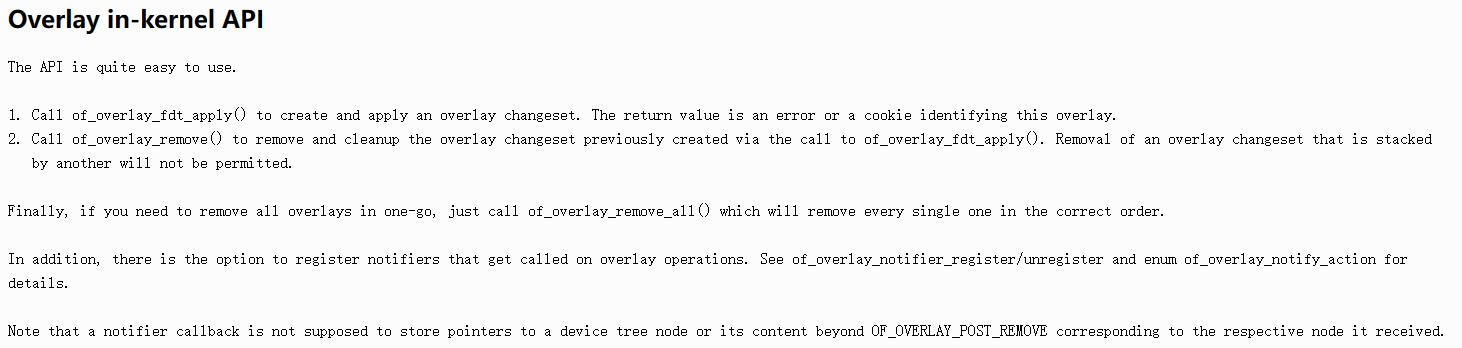
设备树插件(dtbo) 里面的节点也要被转换成 device_node, 有的 device_node 也要被转换成 platform_device。 不过在进行转换之前, of_overlay_fdt_apply 函数会先创建一个改变集。 然后根据这个改变集去进行修改。
创建改变集的目的是为了方便对设备树进行修改和复原。 设备树是一种静态的数据结构,一旦被编译和加载到内核中, 就难以直接修改。 为了解决这个问题, 设备树覆盖功能引入了改变集的概念。
二、改变集简介
改变集是一个描述设备树变化的数据结构, 它记录了对设备树的修改操作, 如添加、 删除或修改节点。 通过创建改变集, 我们可以在运行时对设备树进行动态修改, 而无需修改原始的设备树源文件。
通过创建改变集, 我们可以方便地定义需要进行的修改操作, 而不必直接操作设备树的底层结构。 这提供了一种高层次的抽象, 使我们能够以更简洁和可读的方式描述设备树的变化。同时, 改变集也可以被保存、 传递和应用到其他设备树上, 方便在不同系统或环境中进行设备树的配置和定制。
此外, 改变集还可以用于设备树的复原。 在某些情况下, 我们可能需要在运行时撤销对设备树的修改并恢复到原始状态。 通过应用反向的改变集, 我们可以还原设备树, 使其回到修改之前的状态, 实现修改的复原。
因此, 创建改变集提供了一种方便、 可控和可复原的方式来修改设备树, 使设备树的管理和配置更加灵活和可靠。